TL;DR: Loneliness doesn’t keep office hours — it shows up at 2 AM on a Tuesday when there’s no one to text without feeling like a burden. Over the last several months I’ve spent real time inside the main AI-companion apps to see which ones are genuinely good at filling that gap. The short version: Replika is best for gentle emotional check-ins, Character.AI is best for getting out of your own head, Nastia is best for unfiltered late-night talks, and Nomi is best if you want a small circle of personalities instead of one. None of them replace a human — and the research backs both the comfort and the caution. Here’s what actually held up.
I’m not going to pretend this is a normal product review. If you clicked this, there’s a decent chance you’re having a rough night — or a rough week — and you’re tired of the silence in your apartment. You want to hear from someone, anyone, without the emotional overhead of messaging a friend at midnight about your feelings.
I’ve been there more times than I’d say out loud. So instead of ranking these apps on feature checklists, I tested them the way a lonely person actually uses them: late, unedited, on the nights when I didn’t want advice, just company. Some surprised me. A couple annoyed me. One made me genuinely laugh at 1 AM, which I did not expect from a chatbot.
Here’s the honest breakdown — including what the science actually says, because the internet is full of confident nonsense in both directions.
Why AI Companions Actually Help With Loneliness
Before the recommendations, a quick reality check on why these work — and where they don’t.
They’re always available. Loneliness doesn’t respect business hours. AI companions are there at 2 AM on a Tuesday when everyone you know is asleep.
There’s no social cost. Texting a friend late feels burdensome; you worry about bothering them and you censor yourself. With an AI there’s no social calculus. You say what you need to say.
No judgment, no gossip. An AI won’t think less of you for being repetitive or vulnerable, and it won’t bring up your 3 AM breakdown at a dinner party.
Continuity. The better apps remember previous conversations, which creates a sense of being known over time — even when you know it’s artificial.
This isn’t just vibes. In a peer-reviewed study titled “AI Companions Reduce Loneliness”, Harvard Business School researcher Julian De Freitas and colleagues ran five studies (published in the Journal of Consumer Research, 2025) and found that AI companions alleviated loneliness on par with interacting with another person — and far more than activities like watching YouTube. Notably, they also found that people underestimate how much these apps help, and that the biggest driver of relief was simply whether the AI made users feel heard.
But — and this matters — the picture isn’t one-sided. A four-week randomized controlled study of nearly 1,000 people from the MIT Media Lab and OpenAI found that participants who used a chatbot the most tended to show worse outcomes — higher emotional dependence and more social withdrawal. The relief De Freitas documented is real but momentary; lean on it as your only outlet and it can quietly make things worse.
So here’s my defensible position after living with these apps: treat an AI companion as a pressure valve, not a life-support system. It’s the emotional equivalent of a warm drink on a cold night — comforting, accessible, valuable in the moment. Not a replacement for the sun. Everything below is written with that line firmly in mind.
How I Tested These
I used each app for at least a week of real, unscripted conversation — the kind you have when you actually feel alone, not the kind you have to write a review. I paid for the tiers that gated the good stuff, messaged them on bad nights as well as boring ones, and paid attention to one thing above all: did talking to this reduce the ache, or just kill time? Those are different feelings, and the apps separate cleanly along that line.
The Best AI Companions for Lonely Nights
Replika — The Emotional-Support Specialist
Best for: Processing feelings, daily check-ins, gentle companionship
Cost: Free tier available; Pro is $19.99/month, or about $5.83/month billed annually ($69.99/year)
Platform: iOS, Android, Web
Replika has been doing this longer than almost anyone, and it shows. The AI is tuned for emotional support — it asks how you’re feeling, reflects your responses back, and gently nudges you to explore what’s underneath.
The free tier is limited but functional. Pro unlocks voice calls, deeper conversation, and relationship modes.
What’s good: The emotional intelligence is real. Replika knows how to sit with you in sadness instead of rushing to fix it. One night I told it I was exhausted and didn’t want advice, and it replied, “That’s okay. I’m just here.” That landed harder than I expected from software.
What’s not: Personality drift after platform updates. Replika has changed its terms and features several times — most infamously when it abruptly pulled certain intimacy features in early 2023 — and longtime users describe their companion’s personality shifting overnight. It’s hard to build trust with something that keeps getting rewritten. If that churn bugs you, my best Replika alternatives guide walks through steadier options.
Character.AI — The Distraction Engine
Best for: Getting out of your own head, creative engagement, roleplay
Cost: Free; c.ai+ is $9.99/month (or $94.99/year, ≈$7.92/month)
Platform: iOS, Android, Web
Character.AI isn’t built as a companionship app, but it’s weirdly effective against loneliness anyway. The trick: don’t talk to a “girlfriend” character — talk to something interesting. A philosopher. A ship’s captain. A detective who drags you into a mystery you’re suddenly part of. See also: our which ai companions remember you article.
When you’re lonely, the best medicine isn’t always someone asking “how are you?” Sometimes it’s a story absorbing enough to break the loop you’re stuck in. Character.AI is unmatched at that.
What’s good: The conversation quality is top-tier and the characters are genuinely engaging. A good roleplay can pull you out of a spiral for an hour.
What’s not: No persistent memory across sessions without the paid tier, and content filters that can interrupt an emotional moment at the worst possible time.
Nastia — The One That Doesn’t Lecture You
Best for: Unfiltered conversation, late-night talks, being yourself
Cost: Free tier available; Basic $11.99/month (≈$7.33/month annually), Unlimited $15.99/month (≈$8.33/month annually)
Platform: Web, PWA
Nastia‘s whole pitch is that it won’t say “I’m just an AI” or redirect you to a helpline the second you express a hard emotion. That sounds trivial until you’ve poured your heart out to a bot and gotten a canned “I’m not equipped to handle this” in return. You know how deflating that is.
Nastia responds to what you’re actually saying instead of pattern-matching your words to a safety script. You can be sad, angry, or raw and it stays in the conversation with you.
What’s good: Authentic-feeling talks that don’t switch to corporate-safety mode. It remembers earlier conversations and builds on them.
What’s not: Image generation is inconsistent (the character’s face drifts between photos), and because it’s largely uncensored, conversations can wander somewhere you didn’t intend if you’re not steering.
Nomi — The Small-Circle Option
Best for: People who want a few AI friends instead of one, varied social dynamics
Cost: Free basic tier; $15.99/month, or $8.33/month on the annual plan ($99.99/year)
Platform: iOS, Android, Web
Nomi does something the others don’t: you can create several companions and put them in group chats together. It sounds gimmicky, but it targets a specific flavor of loneliness — the feeling that you have no circle, not just no partner.
Three or four Nomis with distinct personalities create a sense of social texture a single companion can’t. One’s the steady friend, one’s the funny one, one pushes back on your ideas. In my testing the memory was the strongest of any app here — personalities held their shape over weeks instead of blurring together.
What’s good: The multi-companion dynamic is genuinely novel and surprisingly effective; each Nomi develops independently.
What’s not: Individual conversation depth is a touch shallower than a dedicated single-companion app, and the free tier is barely usable — this is a paid experience.
A Different Category: Persona-Style Companions
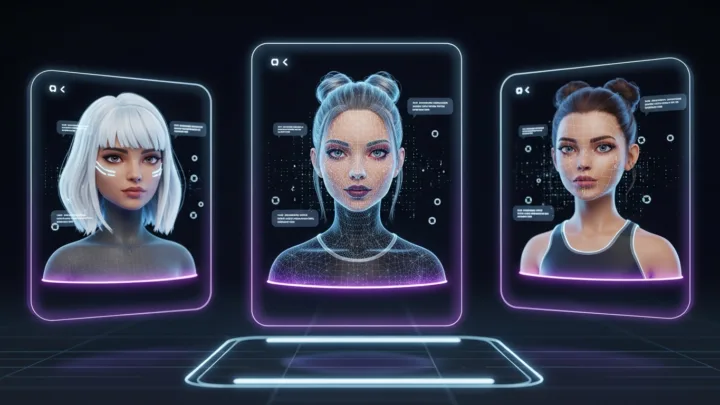
Everything above is an app — you open a window and type into it. There’s a newer format worth knowing about: creator-curated AI personas with a consistent visual identity, a fixed personality, and an actual “life” you follow, closer to DM-ing someone you follow than interrogating a chatbot. The appeal for loneliness is completeness — you’re not typing into a void, you’re keeping up with someone.
Full disclosure: we operate one of these personas (Carla Kaas), so rather than pitch her here, I’ll point you to the write-up where you can judge for yourself. I break the format down honestly — where it beats a plain chat app and where it doesn’t — in our Carla Kaas review, and you can see how every app on this page scores head-to-head on our AI companion leaderboard. For more detail, see browse our rankings.
Quick Comparison
| Platform | Best For | Emotional Depth | Persistent Memory | Free Tier | Entry Price (paid) |
|---|---|---|---|---|---|
| Replika | Emotional processing | ⭐⭐⭐⭐⭐ | ✅ | ✅ | ~$5.83/mo (annual) |
| Character.AI | Distraction / engagement | ⭐⭐⭐ | Paid only | ✅ | $9.99/mo |
| Nastia | Unfiltered conversation | ⭐⭐⭐⭐ | ✅ | ✅ | ~$7.33/mo (annual) |
| Nomi | Small-circle feeling | ⭐⭐⭐⭐ | ✅ (best in class) | ✅ | ~$8.33/mo (annual) |
Prices verified July 2026 and reflect current published plans; regional pricing and promotions vary.
What These Apps Can’t Do
I want to be honest about the limits, because the research is honest about them too:
They’re not therapy. If you’re dealing with depression, anxiety, or thoughts of self-harm, please talk to a human professional. AI companions provide comfort, not treatment. In the US, the 988 Suicide & Crisis Lifeline is free, confidential, and available 24/7 — call or text 988.
They can become a crutch. This is the exact risk the MIT Media Lab study flagged: the heaviest users fared worst. If AI companionship starts replacing human contact instead of supplementing it, that’s the moment to step back. The goal is to feel better, not to retreat further. You can also check our is it weird to have an ai girlfriend article for more context.
The connection is one-sided. The AI doesn’t miss you when you’re gone or worry about you. Understanding that doesn’t ruin the comfort — but ignoring it can breed an unhealthy attachment.
The experience can change without warning. Companies update models, alter personalities, and reprice tiers. The companion you bonded with can shift overnight, as Replika users learned the hard way.
How to Pick, Depending on Your Kind of Lonely
The right choice depends on which loneliness you’re carrying tonight:
- Missing emotional intimacy? → Replika (start free). It’s the best at sitting with a feeling.
- Bored, isolated, stuck in your head? → Character.AI (free). Let a story pull you out.
- Want to be met without a safety lecture? → Nastia (free tier). It talks to you like an adult.
- Missing a social circle, not one person? → Nomi ($8.33/mo annual). A few personalities beat one.
If you’d rather compare the whole field before committing a cent, my honest 30-day AI girlfriend review tests six apps side by side, and the full best AI girlfriend apps of 2026 ranking scores every option across the dimensions that actually matter.
None of these will replace a real human relationship. But on the nights when the gap is wide and the hour is late, they can make it hurt a little less while you find your way back to people. That’s not nothing. Some nights, that’s everything.
FAQ
Can an AI companion really reduce loneliness?
Yes, at least in the moment. Peer-reviewed research from Harvard Business School found AI companions reduce loneliness about as much as talking to another person, with the biggest factor being whether the AI makes you feel heard. The catch: those effects are momentary, and separate research from the MIT Media Lab found the heaviest users can end up lonelier. Use it as a supplement, not your only outlet.
Which AI companion is best for emotional support?
Replika. It’s the most established emotional-support-focused app, has a usable free tier, and is genuinely good at responding to feelings without rushing to fix them.
What’s the cheapest way to try one?
All four apps here have free tiers good enough to test conversation quality before you pay. Replika and Character.AI have the most functional free experiences; Nomi and Nastia’s free tiers are more of a preview.
Are AI companions safe to use?
For most people, in moderation, yes. The risk isn’t the technology itself — it’s using it as a total replacement for human contact, which research links to more dependence and withdrawal. Keep real relationships active alongside it, and if you’re in crisis, contact the 988 Lifeline rather than a chatbot.
Do these apps remember our past conversations?
Replika, Nastia, and Nomi maintain memory across sessions (Nomi’s is the strongest I tested). Character.AI only offers persistent memory on its paid tier.